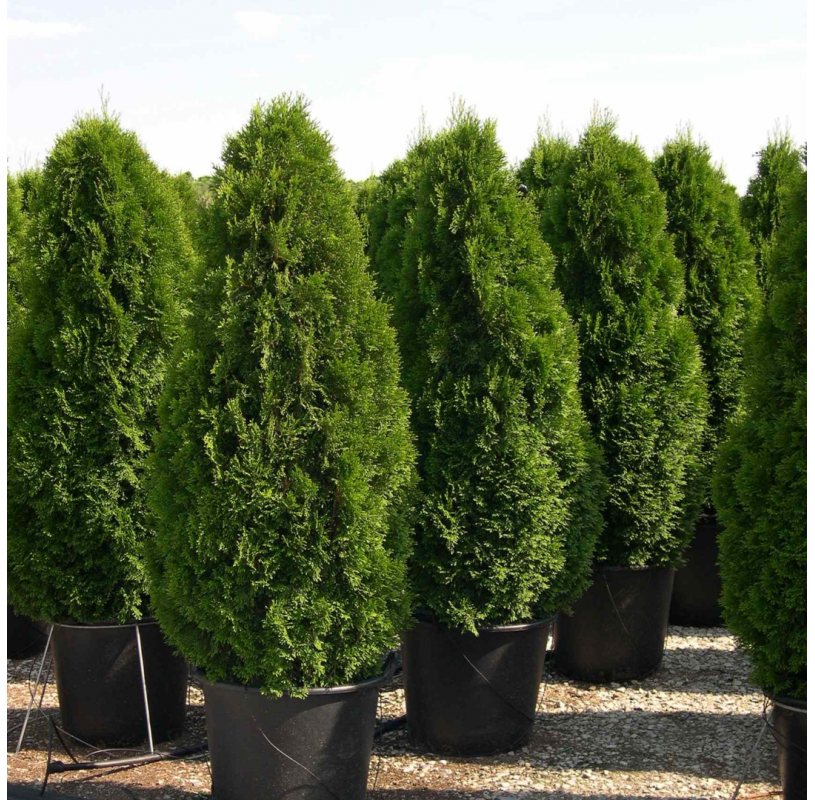
Thuja occidentalis (Northern white cedar / Arborvitae)
Description
Evergreen conifer with a conical to columnar shape and dense, compact branching. It features soft, scale-like foliage of deep green colour, which may turn slightly bronze during winter. Depending on the cultivar, it can reach heights from 5 to 20 metres. It is widely used for hedges, screens, formal alignments and as a specimen tree.
History
It was one of the first North American conifers introduced to Europe, where it quickly became popular in formal gardens and parks. Its ease of cultivation and good tolerance to pruning made it a staple of ornamental gardening from the 18th century onwards.
Origin
Native to northeastern North America, mainly Canada and the northern United States. In its natural habitat it grows in moist areas, open woodlands and along riverbanks.
Curiosity
Native American peoples used its foliage, rich in vitamin C, to prevent scurvy. For this reason, it became known as the “tree of life”, a name that is still commonly associated with thuja species today.
Care
Prefers full sun to partial shade and deep, well-drained but consistently moist soils. Unlike many cypress species, it appreciates a certain level of soil and air humidity and does not tolerate prolonged drought well. It is very cold-hardy and withstands frost without difficulty.
Watering
Regular watering is recommended, especially during the first years after planting and in warm periods. The soil should remain slightly moist, avoiding both complete dryness and persistent waterlogging.
Pruning
Very tolerant of pruning, making it ideal for formal hedges. Prune 1–2 times per year to maintain shape and density. Avoid cutting back into old, bare wood, as regrowth from leafless areas is limited. Regular light pruning keeps plants compact and healthy.
English
Spanish