 English
 Spanish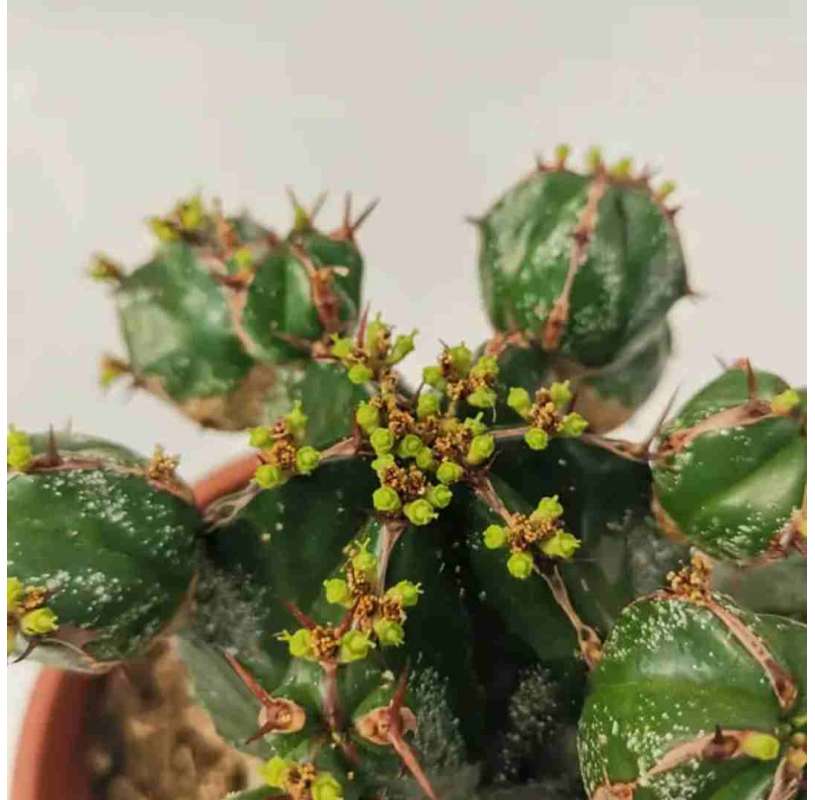

Euphorbia handiensis is a compact, spineless succulent plant native to Fuerteventura in the Canary Islands. Adapted to arid climates, this protected species requires full sun, moderate watering, and well-drained soil. Its toxic sap necessitates careful handling.
 Encrypted payments for greater security
To reduce the plant's time in transit, shipments are made from Monday to Wednesday.


Shipping only to mainland Spain and mainland Portugal
The Euphorbia handiensis is a succulent plant belonging to the Euphorbiaceae family, native to the island of Fuerteventura in the Canary Islands, Spain. It is a species of great botanical and ecological significance due to its rarity and role in local ecosystems.
Description
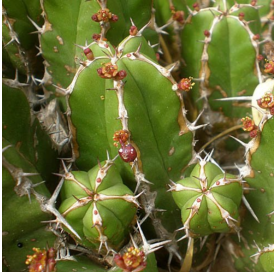
Euphorbia handiensis is a shrub-like plant that can reach up to one meter in height. It has a columnar appearance with vertical stems forming a compact, branched structure. Its color is grayish-green, and the stems are covered with small, short-lived leaves that appear sporadically and fall off quickly. Unlike other Euphorbias, this plant does not have spines. Its flowers are small, greenish, and inconspicuous, typical of the family, and usually appear at the top of the stems in spring.
Origin and History
Endemic to the island of Fuerteventura, Euphorbia handiensis takes its name from the Jandía massif, a mountainous area where its main habitat is found. It grows in arid, rocky terrain, adapted to the harsh conditions of the dry, windy island climate. Due to its limited distribution and habitat loss, it is a protected species, and its conservation is a high priority in the region.
Care
Although native to desert environments, Euphorbia handiensis can be grown in dry gardens or as an ornamental plant in pots, provided its specific needs are respected.
- Location: Requires full sun exposure to grow well. Outdoors, it thrives in dry gardens and arid areas. Indoors, place it in a location with plenty of direct sunlight, such as a south-facing window.
- Soil: Needs sandy, well-drained soil. A mix of cactus soil with coarse sand is ideal to prevent water retention and ensure good drainage.
- Temperature: Adaptable to high temperatures and tolerates extreme heat well. However, it is sensitive to frost, so it should be protected in cold climates during winter.
Watering
Euphorbia handiensis is extremely drought-resistant and requires little watering. During spring and summer, water moderately about once a month, ensuring the soil is completely dry between waterings. In autumn and winter, water sparingly or even not at all in humid climates, as excess moisture can cause root rot.
Pruning
It doesn’t require regular pruning. However, if a branch is damaged, it can be cut with a sharp, disinfected tool. It’s important to handle the plant with gloves, as its sap is toxic and can irritate the skin and eyes.
Fun Facts
- Protected Species: Euphorbia handiensis is listed as an endangered species and is part of conservation programs in the Canary Islands.
- Toxic Sap: Like other species in the Euphorbia genus, it produces a milky sap that is toxic and can cause skin irritation, so caution is advised when handling it.
- Adaptation to Arid Environments: It has developed a high degree of adaptation to the arid and saline conditions of Fuerteventura, making it ideal for low-maintenance gardens in similar climates.
This plant is a unique example of the Canary Islands' biodiversity and represents resilience and adaptation to extreme conditions in its natural environment.

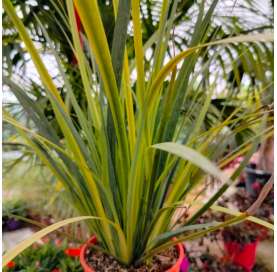



Euphorbia handiensis is a compact, spineless succulent plant native to Fuerteventura in the Canary Islands. Adapted to arid climates, this protected species requires full sun, moderate watering, and well-drained soil. Its toxic sap necessitates careful handling.