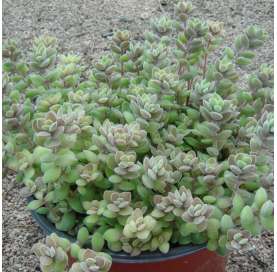


Variegated ground ivy – Glechoma hederacea ‘Variegata’
Description
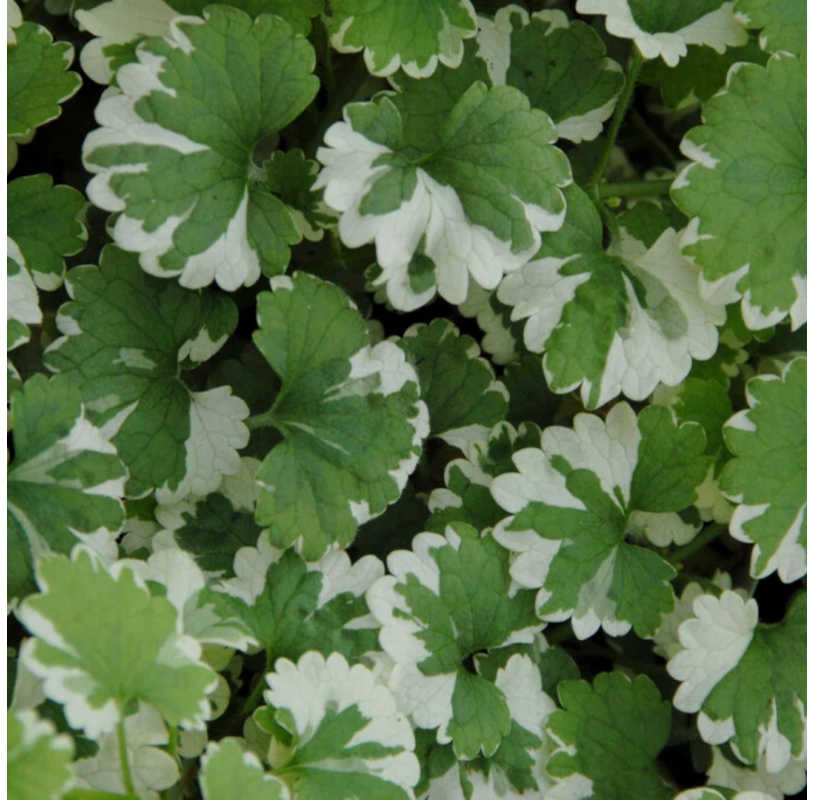
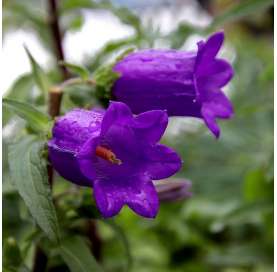
Glechoma hederacea ‘Variegata’, commonly known as variegated ground ivy, is a perennial plant with a creeping, fast-spreading habit, widely used as a ground cover or in hanging containers because of its trailing appearance. Its slender stems spread easily and form a dense carpet over time. Its most striking feature is its rounded to slightly heart-shaped leaves, with scalloped edges and an attractive green and cream variegation that gives the plant a fresh, bright look. During the flowering season, it may produce small violet to bluish flowers.
Origin
Glechoma hederacea is native to Europe and Asia, where it grows naturally in cool, moist, and partly shaded areas. The variegated form is an ornamental selection mainly valued for its decorative foliage.
History
Over time, ground ivy has become part of ornamental gardening because of its ability to cover surfaces quickly and its value in hanging baskets, planters, and mixed arrangements. The variegated variety is especially grown for its bicoloured foliage, which remains attractive even when the plant is not in flower.
Care
It is an easy plant to maintain when given suitable conditions.
- Light: prefers partial shade or bright indirect light, although it can tolerate some gentle sun.
- Soil: likes a fresh, light, and well-drained substrate.
- Position: ideal for planters, hanging pots, borders, and as a ground cover in sheltered areas.
- Resistance: it is a hardy and vigorous-growing plant.
Watering
Watering should be moderate and regular.
- The substrate should be kept slightly moist.
- It does not do well with long periods of drought.
- It is important to avoid waterlogging, although it appreciates some freshness in the soil.
Pruning
Pruning is simple and very useful for keeping it attractive.
- It can be trimmed regularly to control its spread.
- Dry or untidy stems should be removed.
- A light trim helps it become denser and more compact.
Curiosity
One interesting feature of variegated Glechoma is that it is often used in mixed plant arrangements because its pale-edged foliage helps brighten containers and shaded corners. Its creeping and trailing habit also makes it useful both as a ground cover and as a cascading plant in planters.